Zumba Dance: What it is, Classes & Events Near You
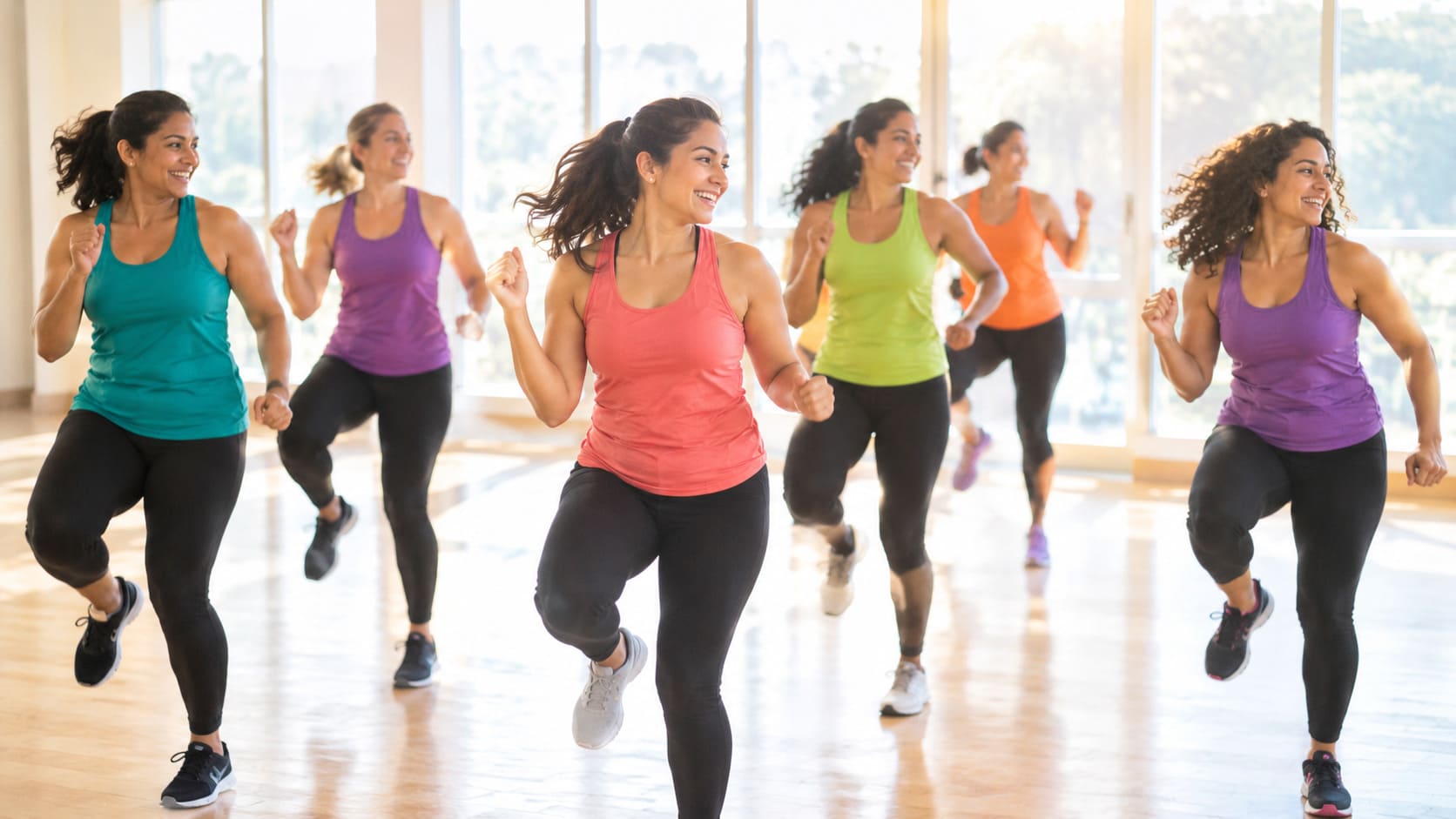
zumba is a latin dance workout built on salsa, merengue, cumbia and reggaeton — invented by accident in colombia in the 1990s. here's where it came from, what actually happens in a class, the eleven formats, and how to find one near you.
the thing nobody tells you about your first zumba class is that the back row is the whole point.
everyone there is half a beat behind. the instructor doesn't count you in, doesn't correct you, doesn't come over. you watch the person in front, you get maybe four of the eight steps, and forty minutes later you've been moving the entire time without once deciding to.
that's the design. it isn't a dance class with a test at the end. it's a room full of people getting it slightly wrong together.
the nearest free one is this friday. devotional zumba at fit kangra 2026, 9 october from 5:00 pm and again saturday 10 october, 5:00–6:00 pm, baan ganga ghat in kangra. no registration, no fee. see it on Gigavent →
What is Zumba?
Zumba is a dance fitness programme built on Latin music, performed as a group class where an instructor leads and the room follows. There is no partner, no sequence to memorise and no stopping to learn a step.
The structure is interval-based: fast songs alternate with slower ones, so effort rises and falls across the hour rather than holding steady. The dancing is the workout — there are no weights and no equipment in a standard class.
Which country is Zumba from?
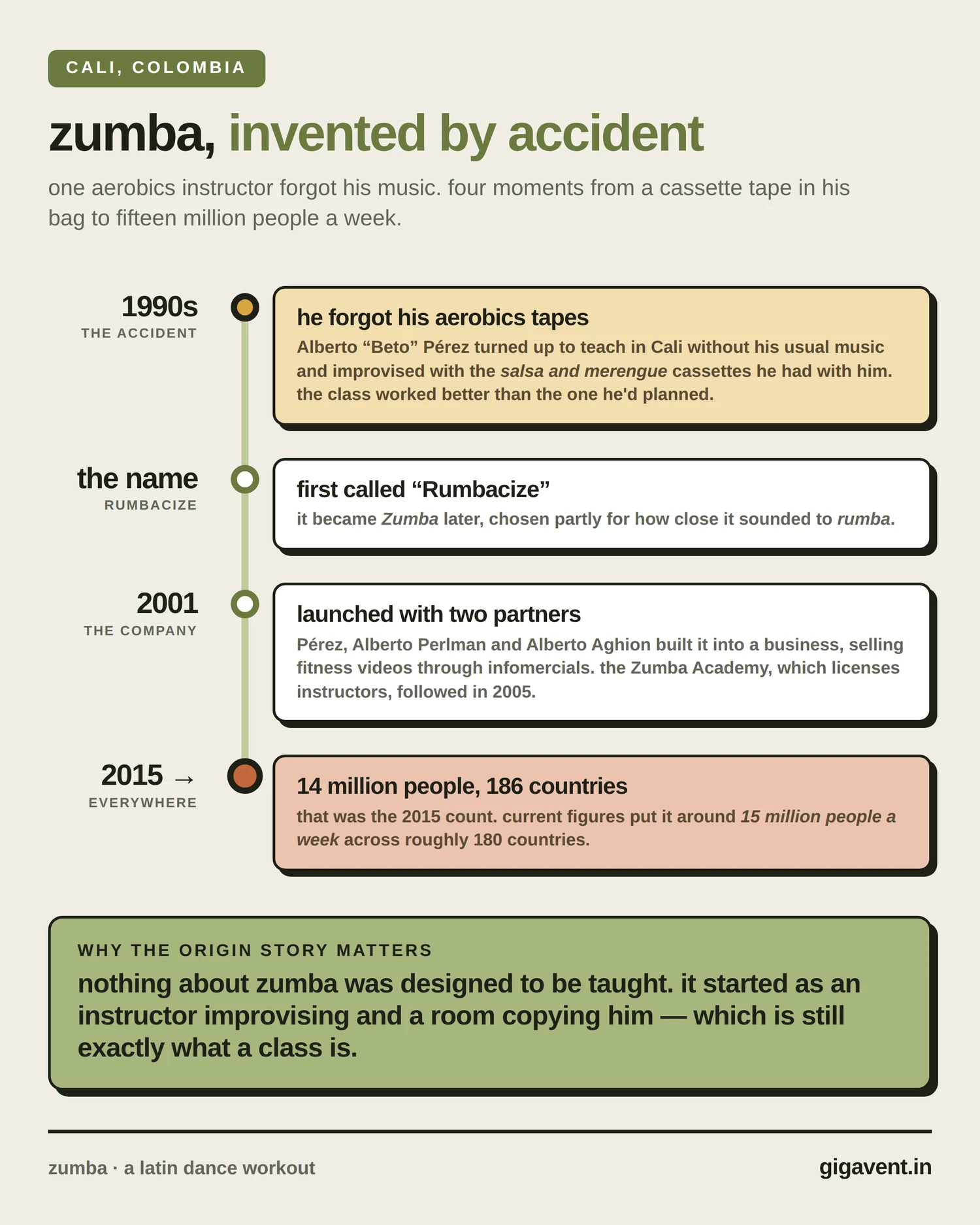
Colombia. It was created in the city of Cali in the 1990s by Alberto "Beto" Pérez, who was working there as an aerobics instructor.
The accident that created it
This is the rare origin story that is actually true and actually an accident.
Pérez forgot his music. Turning up to teach an aerobics class in Cali without his usual tapes, he improvised using the Latin cassettes he had in his bag — salsa and merengue. The class worked better than the one he'd planned.
He first called it "Rumbacize." The name later became Zumba, chosen partly for how close it sounded to rumba.
In 2001 it became a company. Pérez partnered with Alberto Perlman and Alberto Aghion and launched it properly, selling fitness videos through infomercials. The Zumba Academy, which trains and licenses instructors, followed in 2005.
And then it went everywhere. By 2015 there were 14 million participants across 186 countries. Current figures put it around 15 million people a week in roughly 180 countries.
The four rhythms and sixteen steps
Here is the part that makes zumba learnable, and almost nobody says it plainly.
The whole programme runs on four rhythms — salsa, merengue, cumbia and reggaeton — and sixteen core steps between them. Every class you ever attend is a recombination of those.
That matters for a beginner in one specific way: you are not behind, you are early. The steps repeat within the song and across the class and across every class after it. Week three feels completely different from week one, not because you got fitter but because you have seen the steps before.
merengue is the simplest — a march, weight shifting side to side. it's usually where a class starts. salsa adds the step-back and the hip. this is the one that looks hard and isn't. cumbia travels — a step forward, a drag back. reggaeton is the heavy one, lower and more grounded, and it's where the room usually goes loudest.
What actually happens in a class
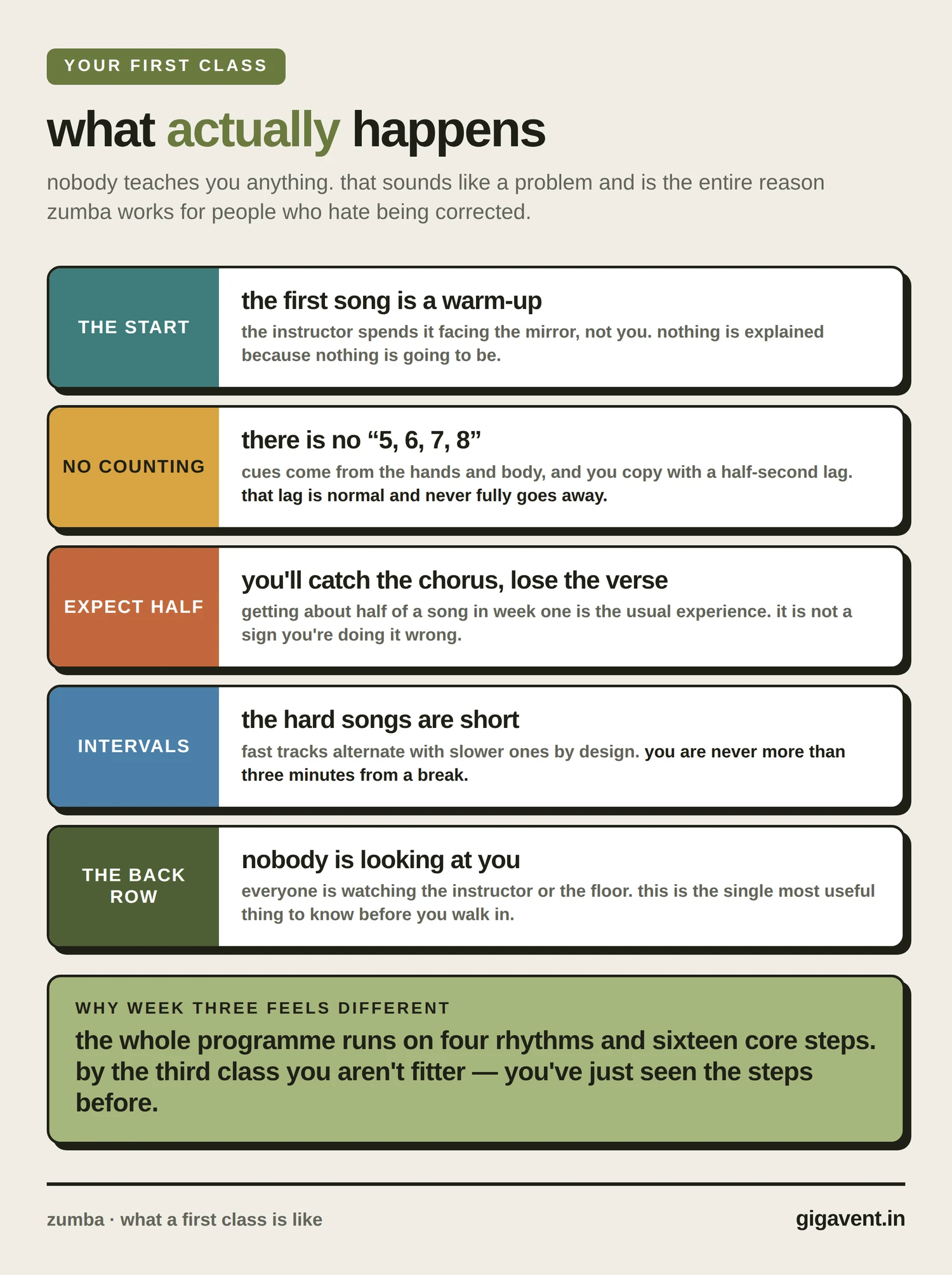
It starts gently. The first song is a warm-up and the instructor spends it facing the mirror, not you.
Nobody counts you in. There's no "5, 6, 7, 8." The instructor cues with their hands and body and you copy with a half-second lag. That lag is normal and never fully goes away.
You will not get a whole song. Expect to catch the chorus and lose the verse. That's the usual experience in week one and it is not a sign you're doing it wrong.
The hard songs are short. The interval structure means the most demanding track is followed by something slower. You are never more than three minutes from a break.
And nobody is looking at you. Everyone in the room is watching the instructor or the floor. This is the single most useful thing to know before you walk in.
that's the whole briefing. the rest is finding a class. open Gigavent →
The types of Zumba class
There are eleven official formats, and knowing the list saves you walking into the wrong one.
| Format | Who it's for |
|---|---|
| Zumba | the standard class |
| Zumba Gold | lower intensity, designed for older beginners |
| Zumba Toning | adds light weighted sticks |
| Zumba Gold-Toning | the two combined |
| Aqua Zumba | in a pool, low impact |
| Zumba Step | with a step platform |
| Zumba Sentao | performed using a chair |
| Zumba Circuit | shorter, circuit-style |
| Zumba Kids | ages 7–11 |
| Zumba Kids Jr. | ages 4–6 |
| Zumbini | ages 0–4, with a caregiver |
If a listing just says "Zumba," it's the standard class. That's the one to start with.
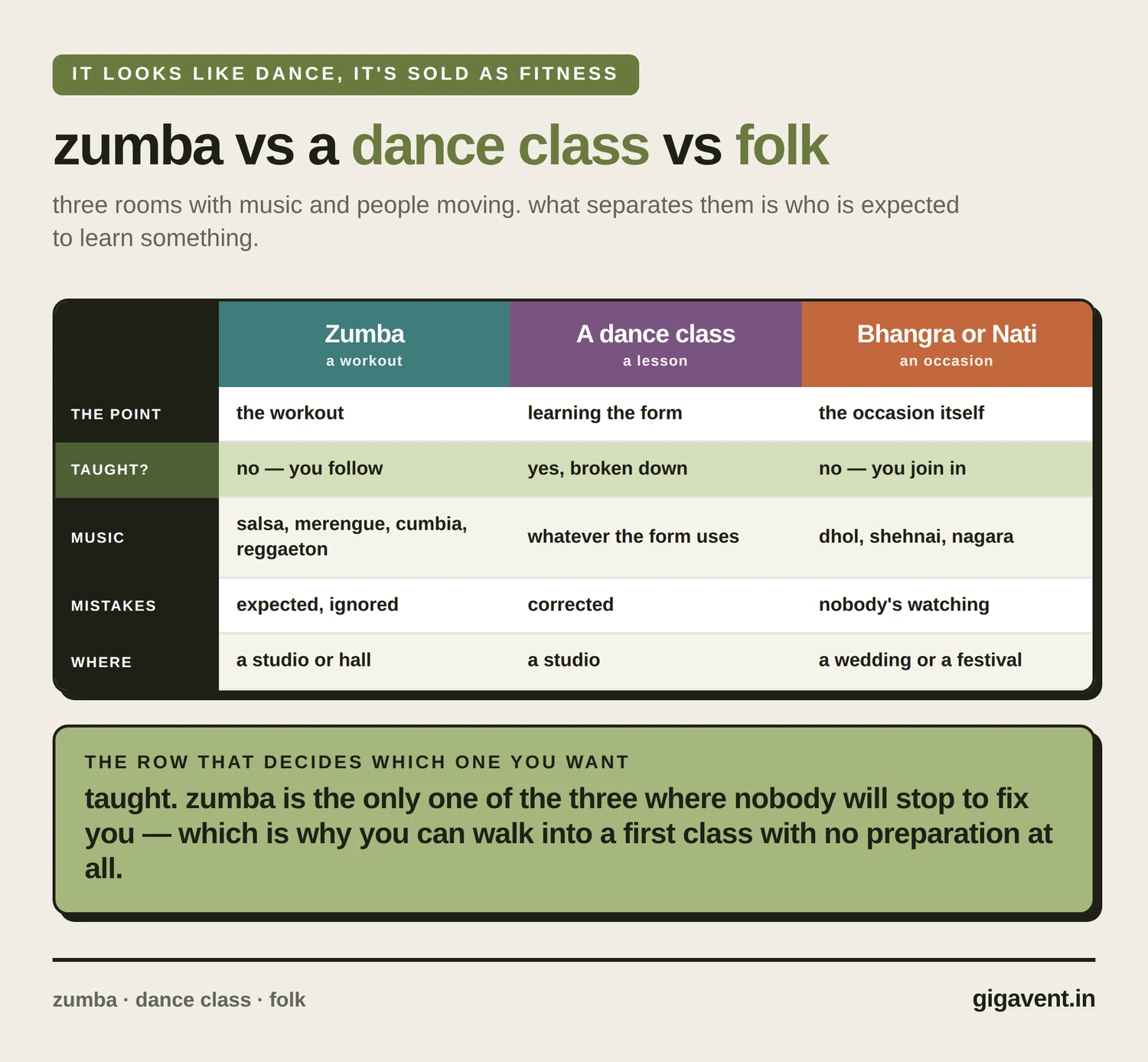
How is Zumba different from a dance class?
The confusion is reasonable — it looks like dance and is sold as fitness.
| Zumba | A dance class | Bhangra or Nati | |
|---|---|---|---|
| The point | the workout | learning the form | the occasion |
| Taught? | no — you follow | yes, broken down | no — you join in |
| Music | salsa, merengue, cumbia, reggaeton | whatever the form uses | dhol, or dhol and shehnai |
| Mistakes | expected, ignored | corrected | nobody's watching |
| Where | a studio or hall | a studio | a wedding or a festival |
The honest summary: zumba is the one where nobody will teach you anything. That sounds like a criticism and isn't — it's why you can walk into your first class without preparation, and why people who hate being corrected stay for years.
Zumba in Kangra and the Dharamshala valley
Honestly: there is not much of it here yet, and that's worth saying plainly rather than pretending otherwise.
What does exist runs quietly. A few instructors take batches out of gyms and studio rooms in Dharamshala, Kangra and Palampur, usually early morning or evening, usually advertised on a poster or in a WhatsApp group and nowhere else. If you search for it you will mostly find nothing — not because nothing is happening, but because none of it is listed.
Festival sessions are the easiest first attempt. Fit Kangra 2026 is running devotional zumba twice — Friday 9 October from 5:00 pm and Saturday 10 October, 5:00–6:00 pm, at Baan Ganga Ghat, free and open. Walking into an outdoor session with a hundred other people is a far lower bar than a studio where everyone already knows each other.
find a class or a session near you →
And if you're the one already teaching a batch, listing it takes a few minutes. A weekly class in this valley is exactly the kind of recurring thing people look for and can't find.
One thing worth knowing: Zumba is a trademark
This catches people out, and it matters more here than it does for a folk dance.
Zumba is a registered brand owned by Zumba Fitness, LLC, not a generic dance style. Instructors are licensed through the company and belong to a network called ZIN. That membership is held by individuals — a gym or studio cannot hold one.
The practical result: a venue can't call itself a Zumba studio, and a class advertised as "Zumba" should be taught by someone licensed to teach it. Plenty of good instructors run excellent Latin dance-fitness classes without a licence — they just can't use that word for it, which is why you'll see "dance fitness" and "aerobics" on so many posters.
None of this affects you as a participant. It's worth knowing mainly so the wording on a poster tells you something rather than nothing.
The quick version
what it is — a Latin dance fitness class, done in a group, following an instructor.
where it's from — Cali, Colombia, created in the 1990s by Beto Pérez.
how it started — he forgot his aerobics music and improvised with salsa and merengue tapes.
the music — salsa, merengue, cumbia and reggaeton, with sixteen core steps between them.
the formats — eleven of them, from Zumbini for toddlers to Aqua Zumba in a pool.
what to expect — nobody counts you in, nobody corrects you, and you'll catch about half of it.
locally — thin on the ground, with Fit Kangra's free sessions on 9 and 10 October the easiest way in.
FAQ
Which country is Zumba from?
Colombia. It was created in Cali in the 1990s by Alberto "Beto" Pérez, an aerobics instructor there.
Who invented Zumba and how?
Beto Pérez, by accident. He arrived to teach an aerobics class without his usual music and improvised with the salsa and merengue cassettes he had with him. He first called it Rumbacize; it became Zumba, and in 2001 he launched it as a company with Alberto Perlman and Alberto Aghion.
Is Zumba hard for beginners?
No, and that's the design. Nothing is broken down and nothing is corrected, so there's no standard to fall short of. Expect to catch roughly half the steps in your first class.
What music is used in Zumba?
Four rhythms form the base — salsa, merengue, cumbia and reggaeton — with sixteen core steps between them. In India most classes also run Bollywood and Punjabi tracks over the same step patterns.
How many types of Zumba are there?
Eleven official formats, including Zumba Gold for older beginners, Aqua Zumba in a pool, Zumba Toning with light weights, and three age-graded children's classes.
Do I need to know how to dance?
No. Zumba is the one group class where not knowing is the normal starting condition, and where nobody will stop to fix you.
What should I wear?
Whatever you'd exercise in, plus shoes you can pivot in — trainers with a lot of grip make the side-to-side turns harder, not easier.
so, kya scene hai — there's a room somewhere near you where everyone is a beat behind and nobody minds. the back row is open.
read next
Fit Kangra 2026 → — three days at Baan Ganga Ghat, 9 to 11 October, with devotional zumba on two of them.
Bhangra dance → — the other one where nobody teaches you and you just join in.
Nati dance of Himachal Pradesh → — this valley's own, and the easiest first dance there is.