Box cricket rules: 14 standard, 6 that vary

Box cricket rules are not standard, and that's the first thing to know. There's no governing body, no official rulebook — every turf makes its own calls.
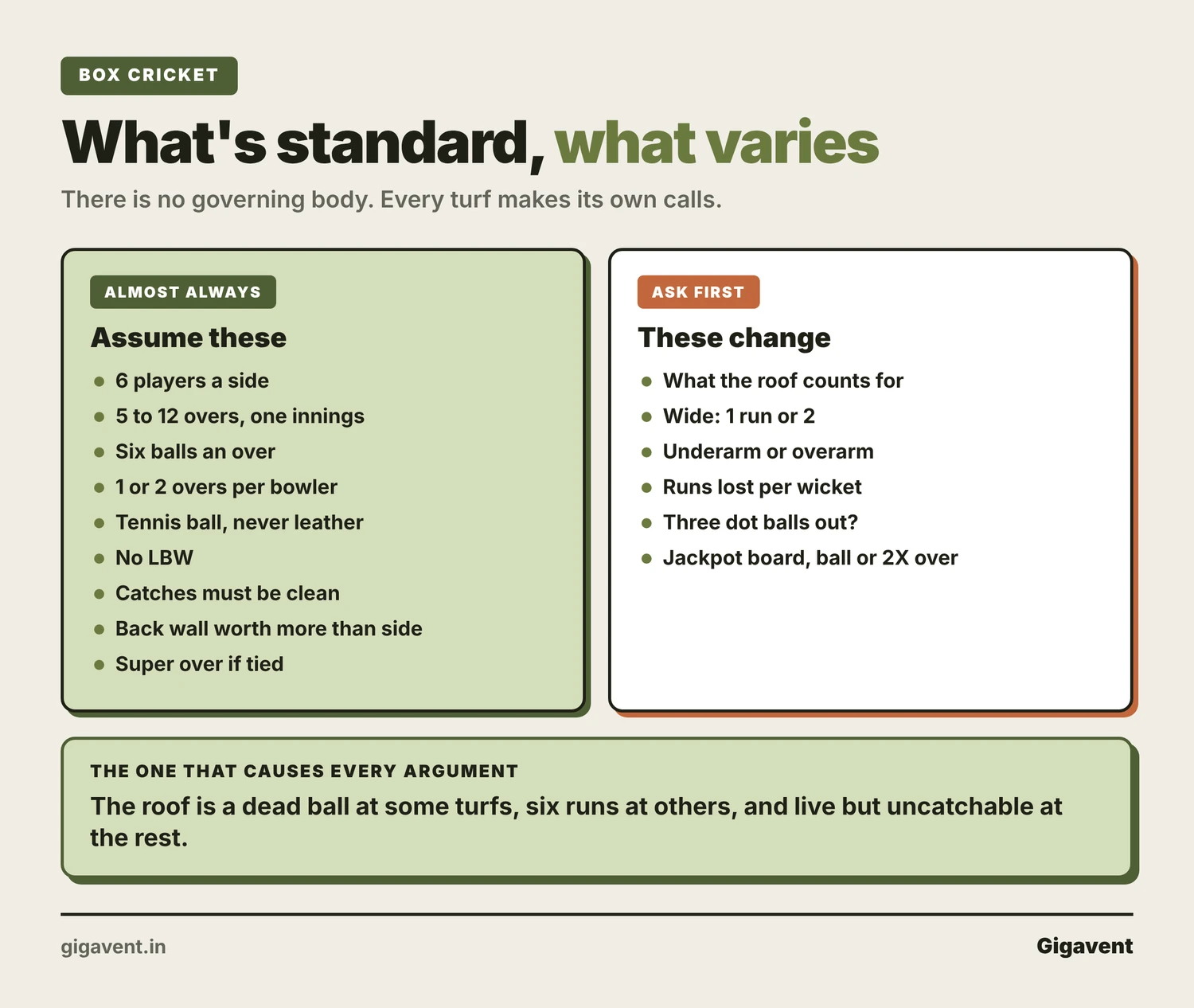
The short answer: about 14 rules are the same almost everywhere, and 6 change from turf to turf. The 14 you can assume. The 6 you have to ask about, and they cause every argument — the roof especially.
Someone hits the roof net, half the group yells six and the other half yells out, and neither is wrong. Their turfs play it differently.
Here's both lists, how scoring works, and what to settle first.
What is box cricket?
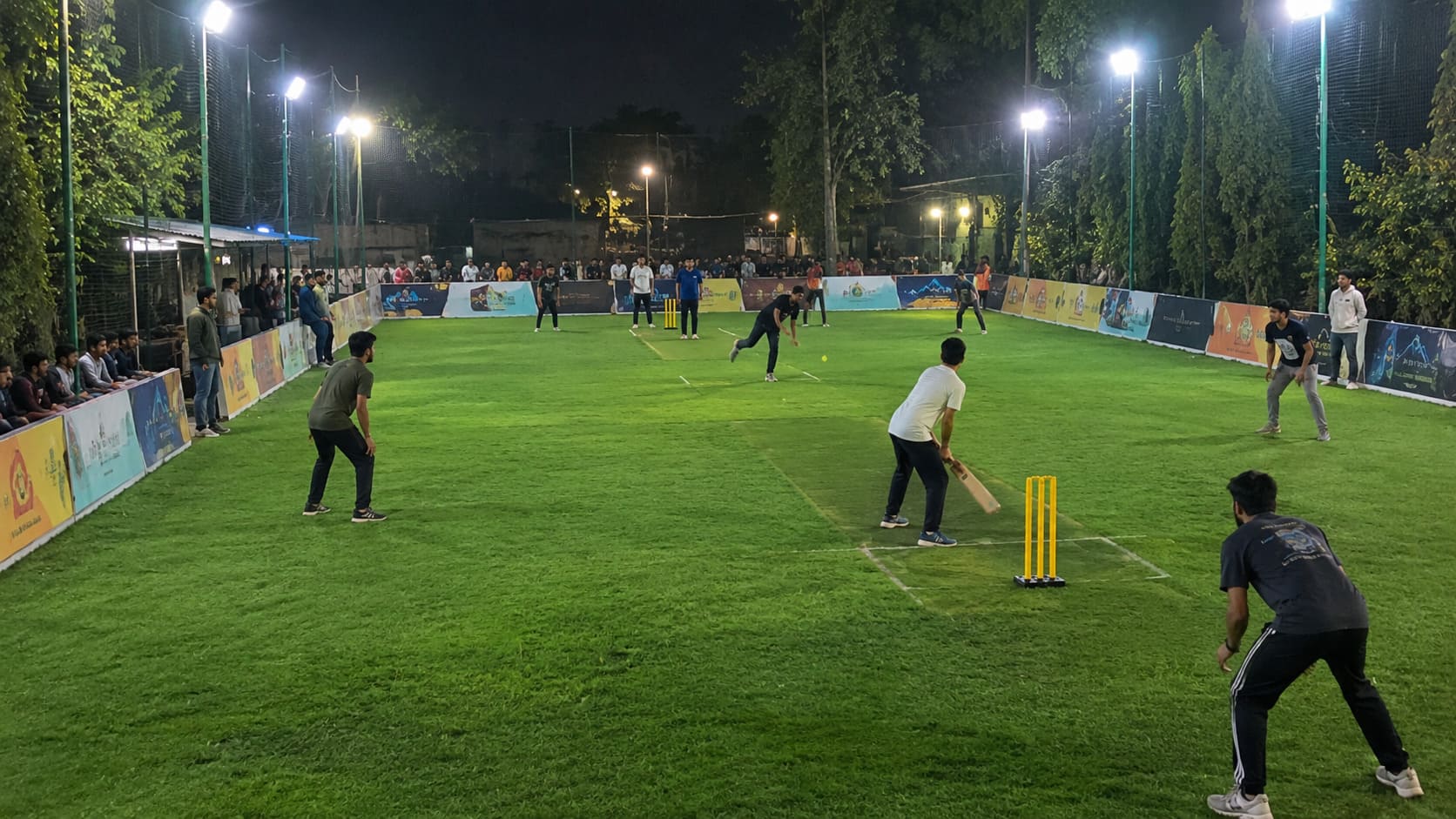
Box cricket is cricket inside a netted enclosure — the "box" — usually artificial turf, six a side, tennis ball.
- The nets are the boundary, so the ball almost never goes dead
- Short overs, small teams — everyone bats and bowls
- Built for a weeknight. A match is 45 to 90 minutes
- Most Indian cities have turfs you can book by the hour
You'll also hear it called turf cricket. Same thing.
How to play box cricket
Never played? It runs about an hour and you'll have it by the end of the first over.
- Book a turf and round up twelve people. Bats, stumps and tennis balls come with the court at nearly every venue, so bring nothing but flat trainers — studs tear artificial turf and most places won't let you on in them
- Split into two sides of six and toss. Batting first is the easier job; chasing on a ground this small gets frantic
- Agree the six variable rules out loud, in front of both teams, before anyone bats — the roof especially. This is the step beginners skip and then spend the rest of the evening arguing about
- One innings each, usually six overs. Everybody bowls one or two and everybody bats, so there's nowhere to hide a weak bowler and no sitting out
- Keep it straight and along the ground. The nets are the boundary, so the ball is almost never dead — straight beats square, and low beats lofted until you've got your eye in
- Highest score wins, and a tie goes to a super over
That's the whole game. Everything below is the detail — and if you're walking onto a turf tonight with a minute to spare, skip to the six variable rules and ask about the roof.
The rules nearly everyone agrees on
These hold at most places in India. Safe to assume unless someone says otherwise.
- 6 players a side. Some venues run 7 or 8, but 6 is the default
- 5 to 12 overs, one innings each. Six is the most common
- Six balls an over. Nobody writes this down, but it's always six
- Each bowler gets 1 or 2 overs. In a 6-over game, usually 2 max for one bowler and 1 each for the rest
- Tennis ball, never leather. Usually a hard tennis ball, sometimes taped
- No LBW. Just forget it exists
- Catches have to be clean off the bat. A rebound off the net or roof is not a catch at most places
- Walls and nets are your boundary. The back or straight wall is worth more than the side walls
- Direct hit on the back wall is 6. Same hit after a bounce is 4
- Max 3 fielders in one half of the court
- Free hit after a no-ball
- Ties go to a super over, one over each
- No powerplay. No fielding restrictions at any stage
- The umpire is final, and the umpire is usually somebody's cousin
Knowing the rules is the easy half. The harder half is finding a game — turfs are everywhere now, but the matches on them don't get advertised. Gigavent lists the ones near you.
How big is a box cricket ground?
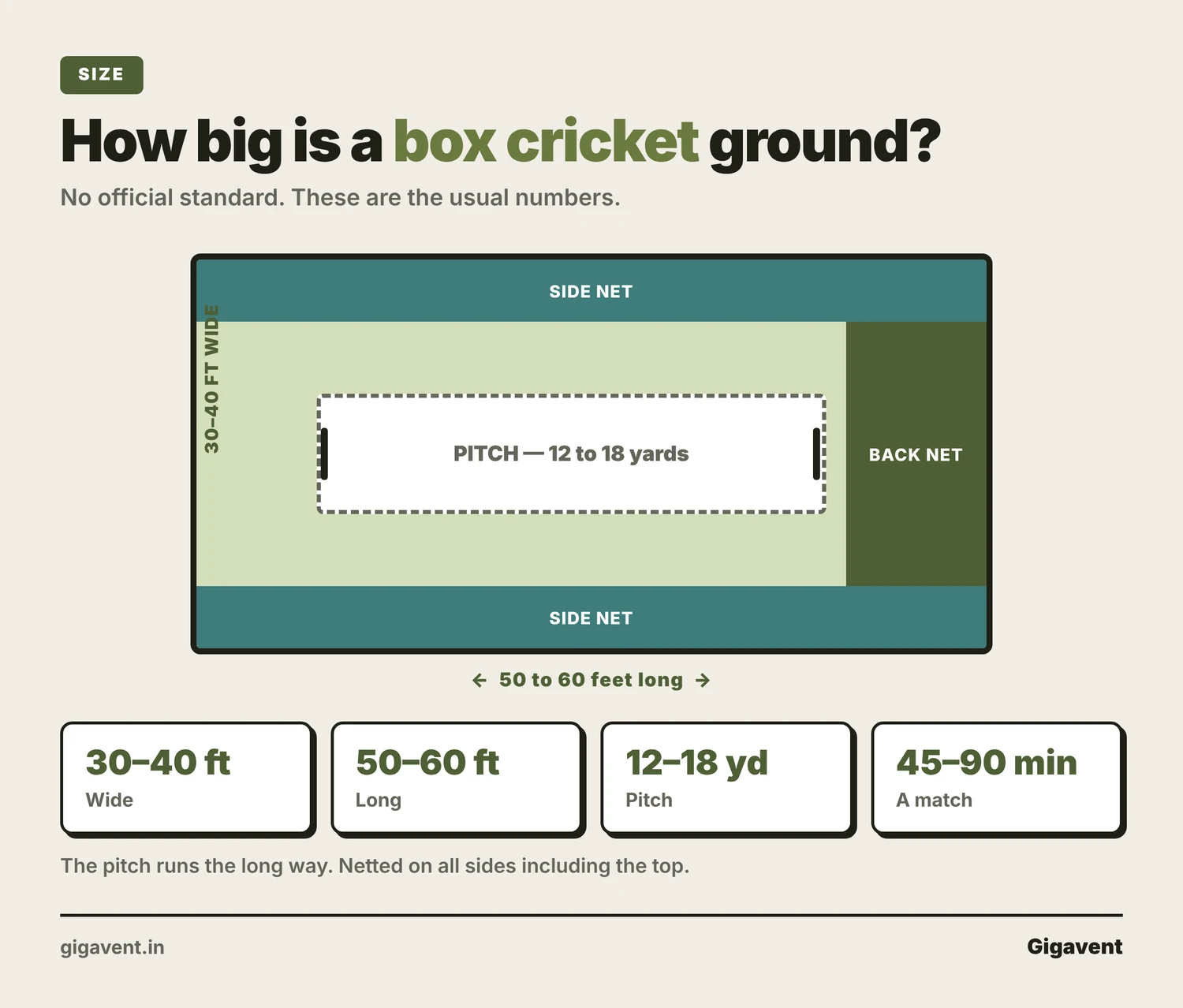
No standard here either, but the usual range:
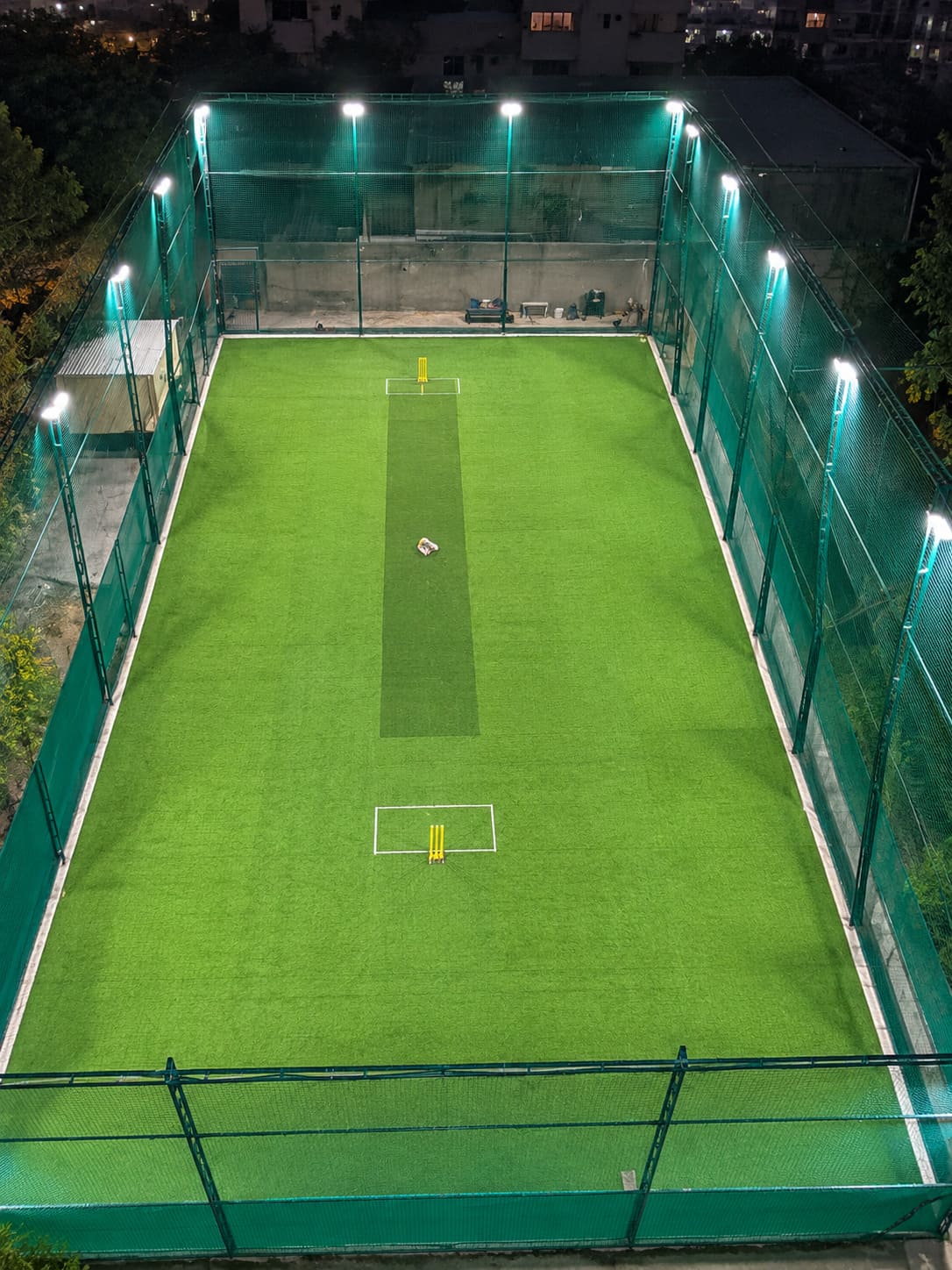
- Court: around 30 to 40 feet wide and 50 to 60 feet long
- Pitch: 12 to 18 yards, against 22 in real cricket
- Netted on all sides, including overhead
- Surface is artificial turf, sometimes cement
Smaller than you're picturing, which is the point. Everything happens faster.
The 6 rules that change from turf to turf
This is the part that causes every argument. Ask before you start.
1. What does the roof count for?
The biggest disagreement in the sport. Three versions:
- Dead ball — no runs, no wicket, carry on
- Six runs — some turfs treat the roof net as a boundary
- Ball stays live — play it, but a catch off the roof doesn't count
All three are normal and all three are in writing somewhere.
2. How much is a wide?
- Most places 1 run
- Some tournaments 2 runs, escalating on consecutive wides — 2, then 4, then 6
3. Can you bowl overarm?
- Underarm is the default at most turfs — below the waist, no run-up
- Some allow restricted overarm from a fixed spot, two-step run-up at most
- One rulebook allows stand-and-throw with no foot movement; another bans throwing entirely
4. Do you lose runs for a wicket?
- Most places no — a wicket just brings the next batter in
- Some formats deduct 5 runs each time you're out
- One variation: you keep batting after you're out and lose 3 runs
5. Is three dot balls out?
- At many turfs, three dot balls in a row and you're out — it stops blocking
- At plenty of others, no such rule
6. Jackpot board, jackpot ball, or a 2X over?
Three different things share the name, and plenty of turfs use none of them:
- Jackpot board — a marked panel on the wall. Hit it directly and it's 8 runs
- Jackpot ball — the last ball of the innings. Runs doubled, and a wicket costs double too
- 2X over — a whole over where everything doubles. A six becomes 12, a four becomes 8, a single becomes 2. Usually the last over, sometimes one the batting side gets to pick
Ask which your turf uses, and if it's a 2X over, which over.
If you're playing somewhere new, ask about these six on arrival rather than mid-over. Worth checking the turf's own page too — listings usually say which format a game is running.
How scoring works
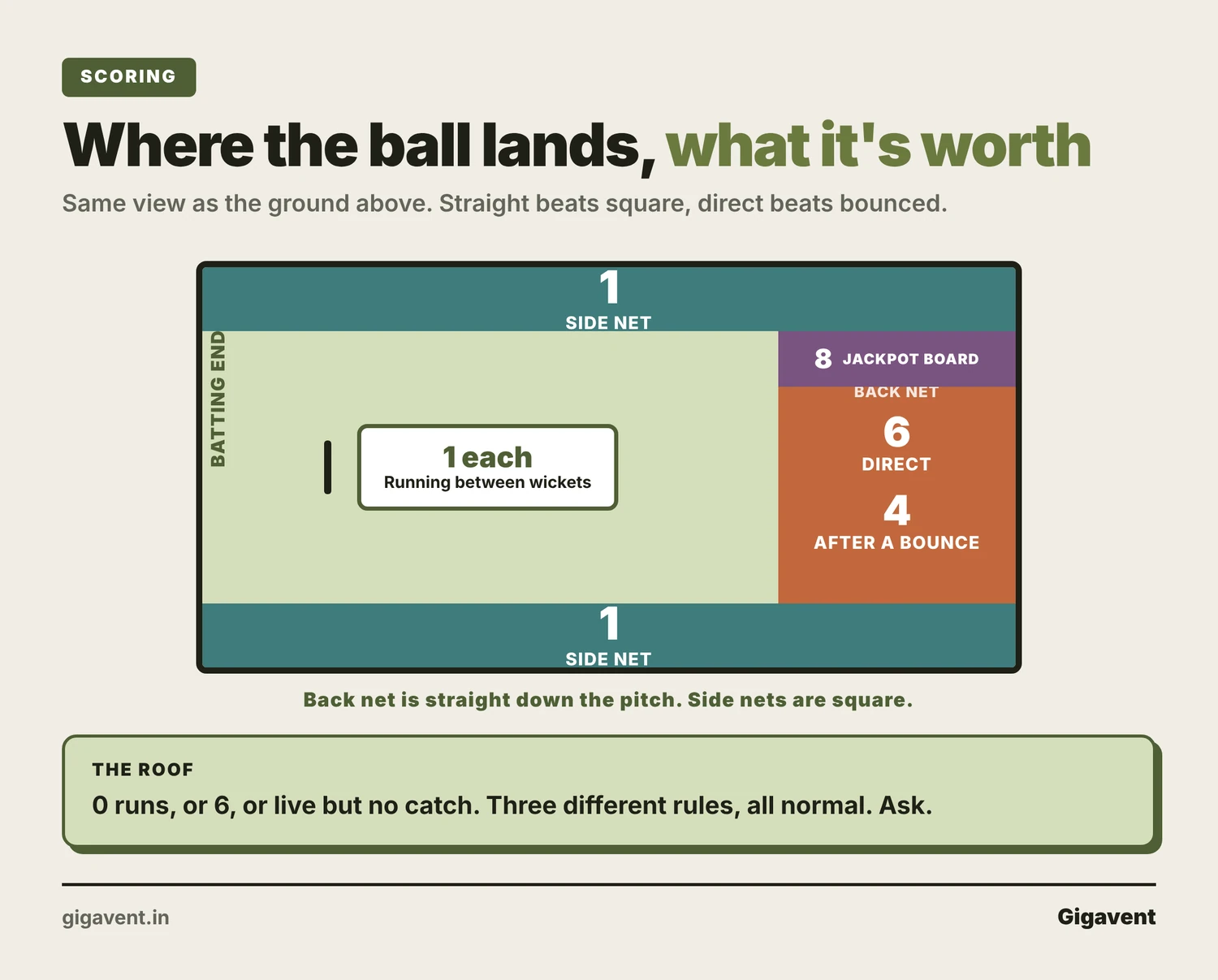
Rough guide, and venue-specific.
- Running between wickets — 1 each
- Side wall or net — usually 1, sometimes nothing
- Back wall, bounce first — 4
- Back wall, direct — 6
- Roof — 0 or 6, depending
- Jackpot board, direct — 8, where one exists
- Out of the playing area — usually nothing
The shape is the same everywhere: straight beats square, direct beats bounced.
What to ask before the first ball
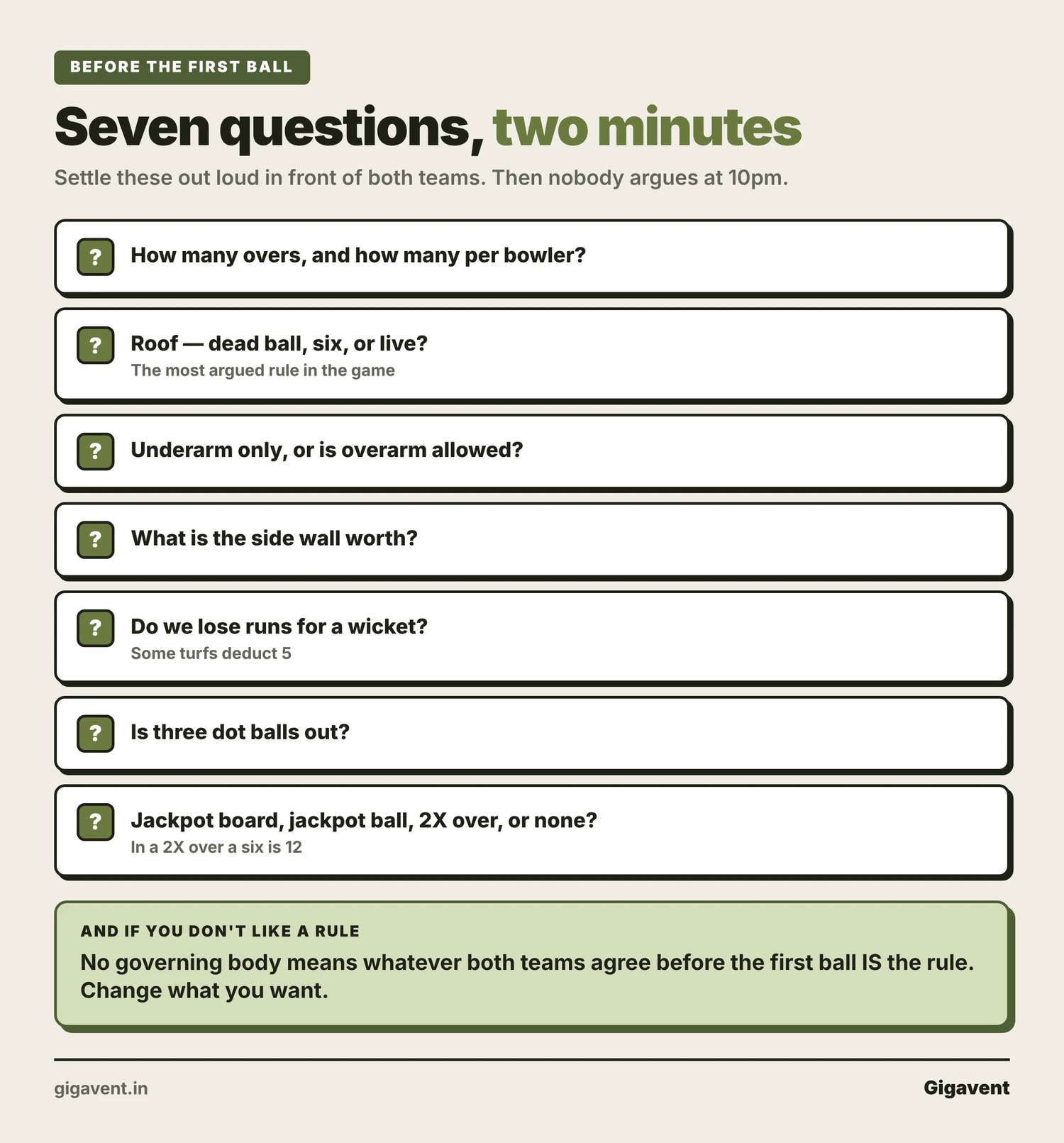
Two minutes of questions saves forty of arguing. Ask the staff or whoever booked.
- How many overs, and how many per bowler?
- Roof — dead ball, six, or live?
- Underarm only, or is overarm allowed?
- What's the side wall worth?
- Do we lose runs for a wicket?
- Is three dots out?
- Is there a jackpot board or jackpot ball?
Decide them out loud in front of both teams before anyone bats. Settle it once and nobody argues at 10pm.
And you don't have to use anyone else's rules. There's no governing body, so whatever both teams agree before the first ball is the rule for that match. Want a 2X over? Want the roof to be six? Want no dot-ball rule because half your side has never played? Agree it, say it out loud, play it. At this level that isn't bending the rules — it's how the game works.
How to get out, and how not to
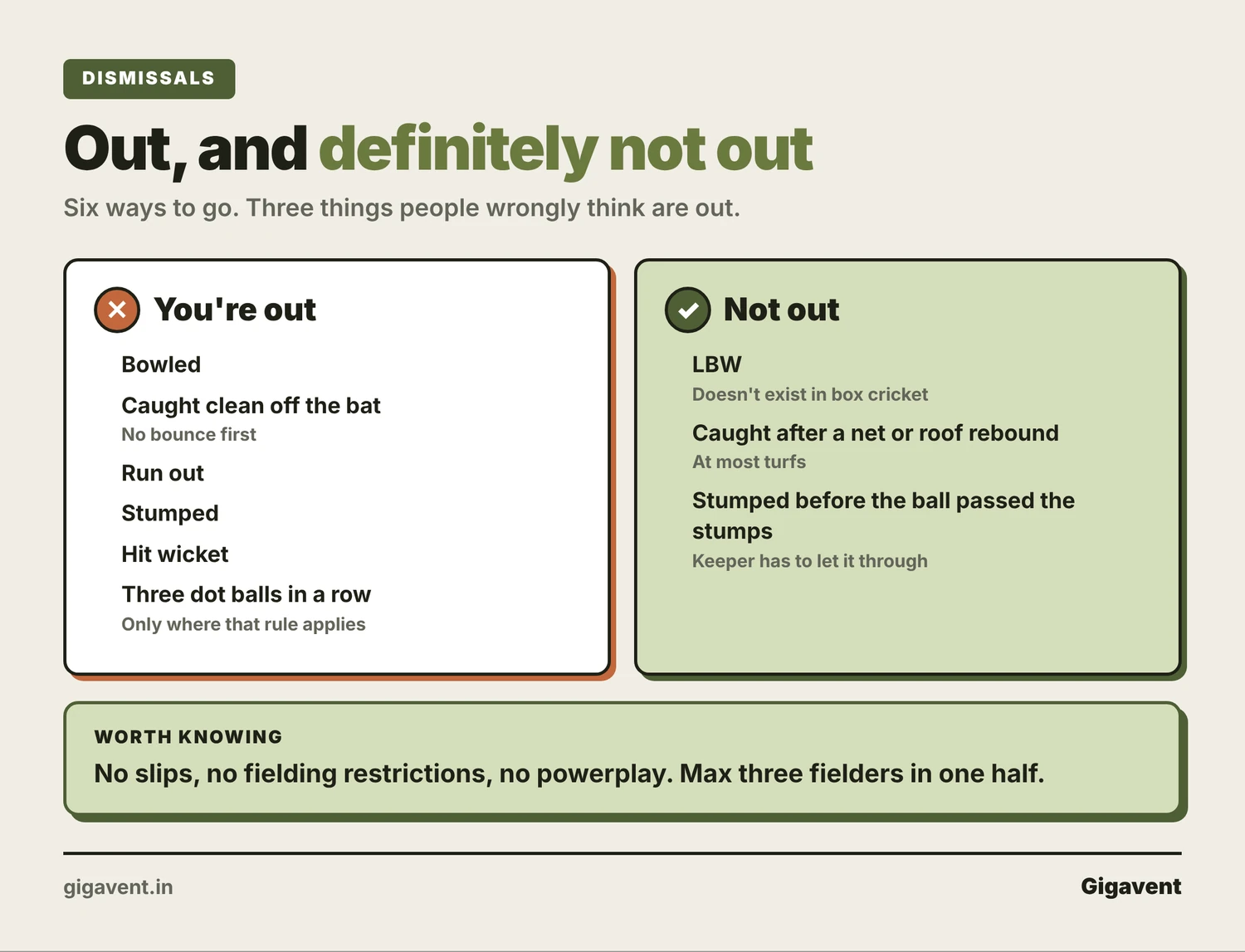
You're out if:
- Bowled
- Caught clean off the bat
- Run out
- Stumped
- Hit wicket
- Three dot balls in a row, where that applies
You're not out if:
- LBW. Doesn't exist here
- Caught after a net or roof rebound, at most turfs
- The keeper grabbed it before it passed the stumps, on a stumping
Box cricket brackets run most weekends in most cities, and plenty let you enter without a full team. We wrote up how local tournaments actually work if you fancy one.
Batting, bowling and fielding tips
The space is tiny and the ball is light, so little from real cricket transfers.
Batting
- Keep it along the ground early. Lofted shots find the side netting, worth 1 at most
- Aim straight. The back wall pays 4 or 6; the sides pay nothing
- A tennis ball skids. Play later than you think
Bowling
- Length beats pace. No room to swing through the line
- Vary it every ball. With 1 or 2 overs each, nobody settles
- Bowl at the stumps. No LBW means a miss costs you nothing
Fielding
- Stand closer than feels right — the court is 40 feet wide and singles are the currency. Watch the rebounds too: a ball off the side net stays live at most turfs, and that's where run-outs come from
Turning up to a turf game alone is completely normal, and it's one of the easier ways to meet people in a new city — more on that here.
Getting twelve people there
The thing nobody writing about box cricket mentions: the rules take two minutes. Getting enough people to show up is the whole game.
You know how it goes:
- You book a turf for Saturday
- Ten say yes in the group, six turn up, two of them late
- Somebody suggests 4-a-side and it isn't the same
If you're short: play fewer a side, ask the turf if another group wants to merge, or bat twice each.
The better fix is not chasing ten people at all. A game posted openly fills better than a group chat where everyone's being polite.
That's the problem Gigavent is trying to solve. Games near you show up with the time, the turf and how many spots are left — so instead of asking around, you can see there's a 7pm match twenty minutes away needing two more, and take a spot. No team needed, nobody to know. Most people joining are doing it alone.
It works the other way too. With a turf booked and four confirmed, you can put the game up — overs, cost per head, players needed — and let people who want to play find it. Same for a full tournament.
Not only cricket — same for this weekend or today.
Box cricket vs regular cricket
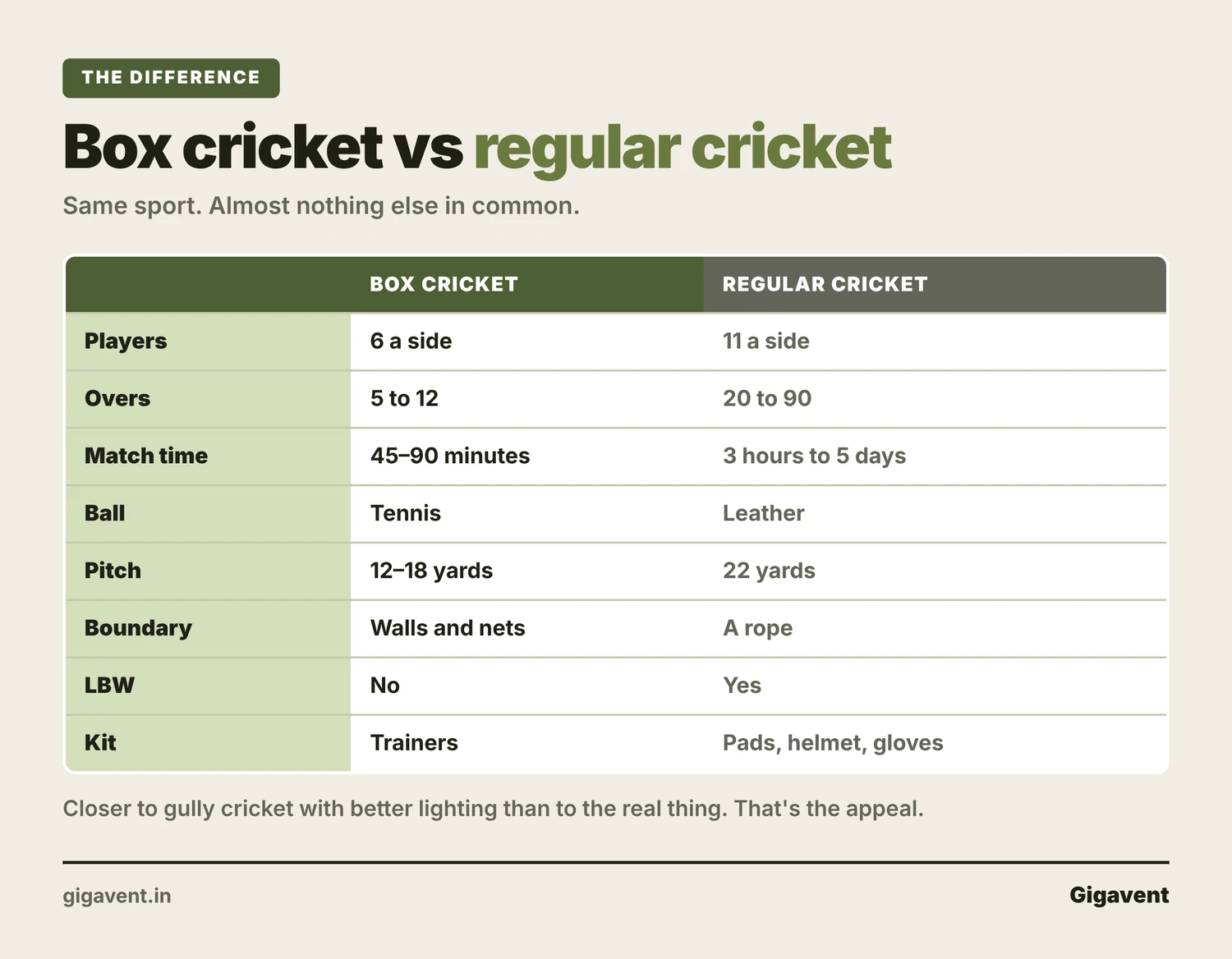
Same sport, almost nothing else in common. Six a side, a tennis ball, nets for boundaries, no LBW, and you turn up in trainers. Closer to gully cricket with better lighting than to the real thing.
Questions people ask
How many players are in box cricket?
Six a side is standard. Some turfs run 7 or 8, a few informal games go to 5. Everyone usually bats and bowls.
How many overs is a box cricket match?
Between 5 and 12, usually 6. One innings each, 45 to 90 minutes in all.
Is hitting the roof out in box cricket?
Depends on the turf, and it's the most argued rule in the game. Some call it a dead ball, some count it as six, some keep the ball live but disallow a catch. Ask first.
Is LBW given in box cricket?
No. Almost no format uses it — the space is too tight and there's no neutral umpire.
Which ball is used for box cricket?
A tennis ball, usually hard or taped. Some places use a soft cricket ball. Never leather — too dangerous in an enclosed space.
Can you bowl overarm in box cricket?
At most turfs, underarm only — below the waist, no run-up. Some allow restricted overarm from a fixed spot. Check first; it changes the game completely.
What size is a box cricket ground?
Usually 30 to 40 feet wide and 50 to 60 long, netted on all sides including the top, pitch 12 to 18 yards. No official standard.
Can beginners play box cricket?
Yes, it's the easiest format to start with. Short overs, a tennis ball and six people means you're batting and bowling within minutes. Nobody's watching your technique.
Is there a one-hand-one-bounce rule?
Not usually — that's a gully cricket rule. But since nothing here is standard, worth asking.
That's the rules sorted. The only thing left is a turf, a time, and ten people who actually show up — which, as above, is the genuinely hard part. Gigavent exists for that bit.